Showing posts with label Breathing. Show all posts

Monday, October 26, 2015

2.48 Describe experiments to investigate the effect of exercise on breathing in humans.

When you exercise, sometimes you end up respiring anaerobically as the body cannot get oxygen around quickly enough. Of course, this depends on the intensity of the exercise. This could be investigated as follows:

  • Ask a friend to volunteer 
  • At rest, have them lie down on the ground (belly up) and count how many times their chest rises in one minute. Record the result.
  • Now, ask them to walk 100m (or any other given distance). Measure their breathing rate the same way as before. 
  • Then ask them to run 100m. Measure breathing rate again.
  • Finally, ask them to sprint 100m. Measure their breathing rate again.
  • Wait until the person's breathing rate has returned to normal. Repeat the experiment from the start 3 times.
  • Take an average of the results
  • Plot a graph of your results
  • Remember to keep the person, distance run, and environment the same.
Dependent variable: Breathing rate (breaths per minute)
Independent variable: Intensity of exercise
Control variables: Distance (100m), person doing the exercise (fitness must be the same), environment (i.e not have one in super hot conditions and another in freezing cold)

Note: results that differ by more that 0.2 should be ignored and should thus not be taken into consideration when taking an average.

An example graph can be seen below. THIS GRAPH DOES NOT EXPRESS THE RESULTS OF THE EXACT EXPERIMENT DESCRIBED but it does express the same idea.
Conclusion: As exercise intensity increases, the breathing rate increases as well.

Sometimes, the image doesn't show up, so the link to it can be found here


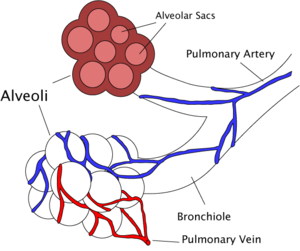
2.46 Explain how alveoli are adapted for gas exchange by diffusion between air in the lungs and blood in capillaries


The alveoli are adapted to the job of making gas exchange quick and effective because (they have...) :
  • Walls one cell thick make diffusion quick and easy
  • There are a lot and they look a bit like bunches of grapes, meaning an enormous surface area - this means the blood stream is in contact with a large surface, and gas exchange happens quickly
  • Moist lining helps gases dissolve and diffuse into it
  • Constant blood flow allows all the blood to be oxygenated effectively
Figure 1: Diagram :)

2.45 Understand the role of the intercostal muscles and the diaphragm in ventilation

Intercostal Muscles
As you breathe in...

  • The muscles contract
  • The ribs move up and outward
As you breathe out...
  • The muscles relax
  • Ribs move in and down
Diaphragm
As you breathe in...
  • The diaphragm contracts, moving down
  • Low pressure is created inside the lungs,  forcing air in
  • Diaphragm pulls down
As you breathe out...
  • The diaphragm relaxes 
  • Pushes upwards
  • High pressure is created inside the lungs, forcing air out
Source: BBC BitesizeFigure 1: A diagram of the respiratory system


2.44 Describe the structure of the thorax, including the ribs, intercostal muscles, diaphragm, trachea, bronchi, bronchioles, alveoli and pleural membranes

How air travels...
Mouth/nose→Trachea→Bronchi→Bronchioles→Alveoli→Gas exchange occurs and then the process happens in reverse (i.e. from alveoli to bronchioles)

The functions of each of these parts:

Ribs - These are curved bones that embrace and protect the lungs from damage. They are linked together by intercostal muscles.

Intercostal muscles - Located between the ribs and expand and contract as the lungs fill or deflate. They keep the ribs in place too.

Trachea - Lined with C shaped (or U shaped, depends how you think of it) rings of cartilage, these protect it from being crushed. This is the pipe that air travels down from the mouth or nose.

Bronchi - The two tube like structures that divide the trachea, one leading into each lung. 

Bronchioles - Smaller tube like structures that contain alveoli at the tips and lead the air in and out of them

Alveoli - Tiny, grape-like air sacs surrounded by capillaries where gaseous exchange occurs

Pleural membranes - The outer lining of the lungs, which would feel kind of wet, and stops the lungs sticking to the ribs, as well as reducing friction. 

Figure 1: A diagram of the human thorax

2.38 Understand the role of diffusion in gas exchange

Diffusion is the random movement of particles from an area of high concentration to an area of low concentration. This is exactly what happens in gas exchange. 

It occurs in the alveoli, in the lungs, where oxygen is transferred into the bloodstream and carbon dioxide diffuses out of the blood and is exhaled. 


There is a high concentration of oxygen in the alveoli and a low concentration in the deoxygenated blood coming into the lungs. That is how diffusion occurs.

There is a high concentration of carbon dioxide in the blood coming into the lungs, which diffuses back into the alveolus and gets exhaled out of the body. 
↓↓↓
The gases move across the wall of the alveolus. 

Figure 1: A pulmonary alveolus