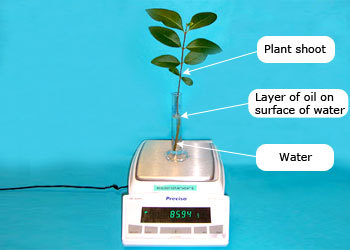
- Weigh the plant at the start
- Put it in a test tube with only its roots / end in the water
- Put a layer of oil over water
- Leave for x amount of time
- Weigh plant again
- Record results
- Repeat, changing one variable (i.e temperature)
Showing posts with label Plants. Show all posts
Tuesday, May 31, 2016
2.56 Describe experiments to investigate the role of environmental factors in determining the rate of transpiration from a leafy shoot
2.55 Explain how the rate of transpiration is affected by changes in humidity, wind speed, temperature and light intensity
Humidity
Decreases amount of transpiration because the concentration of H₂O in the air will equal that of the plant, so it can't move from high to low concentration as per usual
Wind
Increases transpiration because water is blown away, which means there is a greater difference in H₂O concentration
Temperature
Increases transpiration: the heat makes the water evaporate more quickly.
Light intensity
Stronger light means more transpiration because leaves absorb more heat from the light, so water evaporates quicker
Decreases amount of transpiration because the concentration of H₂O in the air will equal that of the plant, so it can't move from high to low concentration as per usual
Wind
Increases transpiration because water is blown away, which means there is a greater difference in H₂O concentration
Temperature
Increases transpiration: the heat makes the water evaporate more quickly.
Light intensity
Stronger light means more transpiration because leaves absorb more heat from the light, so water evaporates quicker
2.54 understand that transpiration is the evaporation of water from the surface of a plant
Transpiration is when water evaporates from the surface of a plant; typically below the leaf because of the stomata being opened by guard cells
2.53 Explain how water is absorbed by root hair cells
- Water is absorbed by osmosis
- (Minerals absorbed by active transport)
- Hair cells are long in shape, giving it a large surface area (also, they branch)
- Epidermal cells increase surface area further
- Makes osmosis faster and more efficient
- Substances are transported by the xylem
2.67 Understand the origin of carbon dioxide and oxygen as waste products of metabolism and their loss from the stomata of a leaf
Both CO₂ and O₂ are waste products of metabolic reactions:
- CO₂ + H₂O > C₆H₁₂O₆ + O₂ (photosynthesis)
- C₆H₁₂O₆ + O₂> CO₂ + H₂O (respiration)
which are carried out by plants.
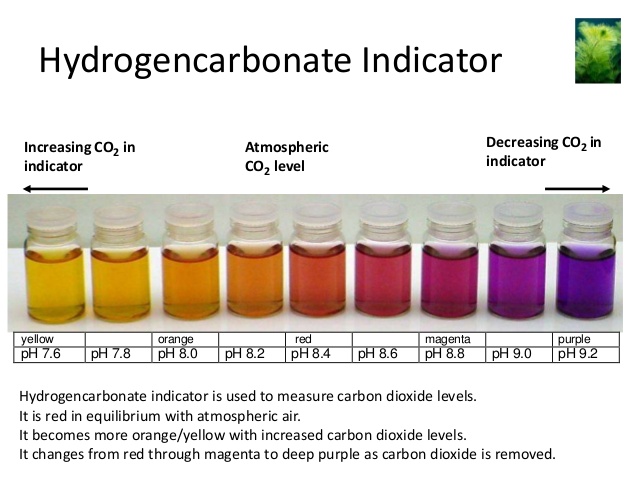
2.43 Describe experiments to investigate the effect of light on net gas exchange from a leaf, using hydrogen-carbonate indicator
As light increases, so does photosynthesis. A hydrogen carbonate indicator, like limewater, is an indicator for CO₂.
- Normal: orange
- Increase: yellow
- Decrease: purple
- Fill a test tube 1/4 full with HCl.
- Attach leaf to bung and leave it in there
- Vary light intensity every x minutes
- (Change distance y from leaf)
- Record results
- done
Monday, May 30, 2016
2.22 Describe experiments to investigate photosynthesis, showing the evolution of oxygen from a water plant, the production of starch and the requirements of light, carbon dioxide and chlorophyll
Pond weed experiment
- Pond weed in large beaker with water
- Count bubbles released in 1 minute
- Record results and repeat 3x
- Repeat, changing either temperature, concentration of CO2, light intensity and / or plant species
Image of apparatus
Sunday, May 29, 2016
2.21 Understand that plants require mineral ions for growth and that magnesium ions are needed for chlorophyll and nitrate ions are needed for amino acids
This means that plants need mineral ions from the soil as well as sunlight and water for growth. Different mineral ions are absorbed for different reasons, and the two you need to learn are:
- Magnesium ions, needed for chlorophyll
- Nitrate ions, used for amino acids
- Magnesium ions, needed for chlorophyll
- Nitrate ions, used for amino acids
Monday, May 23, 2016
To Learn: Plants
List of things that should take priority in revision:
- Transpiration is important to plants because it allows a steady stream of water to happen - when water moves out through transpiration, more water can be pulled in through the roots. This is possible because water is cohesive (molecules of water are attracted to each other). If you put little blobs of water on a desk that is slippery enough and they are close, the two little blobs will form one bigger blob.
- In intense light, guard cells become turgid, which causes the stomata to open, so rate of transpiration increases
- When the stomata is open, carbon dioxide, oxygen and water vapour can diffuse in (so photosynthesis can occur) and excess water vapour can diffuse out
- Using this apparatus, rate of water loss can be measured, because the bubble moves up with the intake of water. The faster the intake, the faster the rate of transpiration.
- To investigate the effect of wind speed, temp, etc. on the experiment above, just modify the environment; i.e. for wind, add a hairdryer, etc.
Subscribe to:
Posts (Atom)