- Some energy is used at the current trophic level in life processes
- Some food the organism takes up is undigested and passed as faeces
- Organism might not eat everything (i.e. a rabbit won't eat a cabbage's roots, so won't gain 100% of its energy even if no energy was used by the cabbage)
Showing posts with label Feeding relationships. Show all posts
Showing posts with label Feeding relationships. Show all posts
Wednesday, June 1, 2016
4.7 Explain why only about 10% of energy is transferred from one trophic level to the next.

4.6 Understand the transfer of substances and of energy along a food chain
When one organism eats another, the substances and energy from it get transferred to its consumer. I.e. if you eat a kilo of spinach, the energy and nutrients from that are transferred to you (don't try that please)
2.90 understand the sources, roles and effects of the following hormones: ADH, adrenaline, insulin, testosterone, progesterone and oestrogen

Tuesday, May 31, 2016
4.5 Understand the concepts of food chains, food webs, pyramids of number, pyramids of biomass and pyramids of energy transfer
Food chain
Shows energy transfer between producers all the way to tertiary consumers. Only 1 line
eg: grass > zebra > lion
Food web
Shows links between various food chains within the same habitat or environment
eg:

Pyramid of numbers
Shows number of organisms in each trophic level and isn't always a nice pyramid shape
eg:

Pyramid of biomass
Shows mass of organism in each trophic level, and is almost always a pyramid shape
eg:

Energy transfer pyramid / chain
Shows energy transfer between organisms, typically in a food chain
eg

Shows energy transfer between producers all the way to tertiary consumers. Only 1 line
eg: grass > zebra > lion
Food web
Shows links between various food chains within the same habitat or environment
eg:

Pyramid of numbers
Shows number of organisms in each trophic level and isn't always a nice pyramid shape
eg:
Shows mass of organism in each trophic level, and is almost always a pyramid shape
eg:
Shows energy transfer between organisms, typically in a food chain
eg

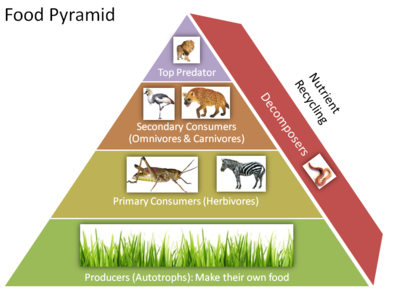
4.4 Explain the names given to different trophic levels to include producers, primary, secondary and tertiary consumers and decomposers
Producers
Produce their own 'food' (glucose) from the sun's light energy
Primary consumer
Eats (consumes) producer and gains its energy; often a herbivore
Secondary consumer
Eats (consumes) primary consumer and gains its energy; often an omnivore
Tertiary consumer
Eats secondary consumer and gains its energy; top of the food chain; often a carnivore
When these die, they're broken down by fungi and bacteria. Nitrogen and carbon compounds are returned to the earth (see cycles)

Produce their own 'food' (glucose) from the sun's light energy
Primary consumer
Eats (consumes) producer and gains its energy; often a herbivore
Secondary consumer
Eats (consumes) primary consumer and gains its energy; often an omnivore
Tertiary consumer
Eats secondary consumer and gains its energy; top of the food chain; often a carnivore
When these die, they're broken down by fungi and bacteria. Nitrogen and carbon compounds are returned to the earth (see cycles)
Subscribe to:
Posts (Atom)