Showing posts with label Cloning. Show all posts

Wednesday, February 22, 2017

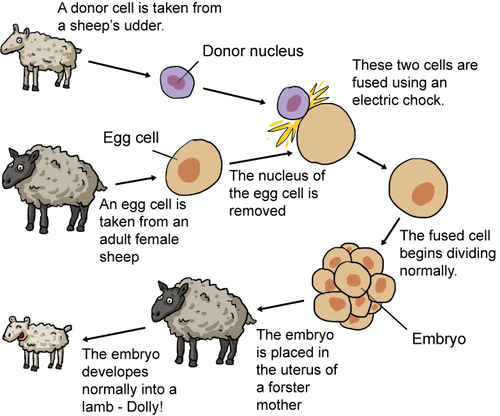
5.19 Describe the stages in the production of cloned mammals involving the introduction of a diploid nucleus from a mature cell into an enucleated egg cell, illustrated by Dolly the sheep


The stages are as follows:
  1. Remove a donor (diploid) cell with the full genetic information (contained in the nucleus)
  2. A cell must be obtained, but one with the capacity to divide. Thus, an egg cell is taken from a sheep.
  3. The egg cell nucleus is removed (it is enucleated)
  4. Desired DNA is placed into the egg cell. They are fused together with an electric shock. 
  5. This newly combined cell divides by mitosis to produce a sheep embryo.
  6. The embryo is placed into the womb of another sheep (the surrogate mother)
  7. As the cells continue to divide, it will grow into a fetus and eventually be born.
The cloned sheep will have the DNA of the cell donor.
Source: http://media1.shmoop.com/images/biology/biobook_biotechnology_graphik_18.png


5.20 Evaluate the potential for using cloned transgenic animals, for example to produce commercial quantities of human antibodies or organs for transplantation.

As mentioned, one use of cloned, transgenic animals (meaning they have had another organism's DNA inserted into them) is to produce commercial quantities of human antibodies or organs for transplantation. Some examples include:


  • Cows with medicine in their milk can be cloned
  • Pigs with human hearts can be cloned for organ transplant


Animals can be given genes to produce human antibodies, which can be later injected into humans to help them face infection, rather than allow the immune system to find the appropriate antibody (which would likely take much longer). 

Sheep and cows can be modified to produce human proteins in their milk, which makes it more beneficial for us.

Animals with organs similar enough to human ones can be used for transplants, which would significantly reduce the problem of shortages. However, this may be a problem for ethical reasons (i.e. it can be considered inhumane to breed animals only to cut out their organs)

There are advantages and disadvantages of the process:

😃

  • Cloning can happen at any time of year (out of breeding season)
  • Infertile animals can be cloned
  • Desired traits can be passed on with almost 100% certainty
😓
  • Cloned animals may develop problems 
  • Cloning is a relatively new technology, meaning that it may have negative consequences that we are not aware of 
  • Low success rate (many animals will die horrible deaths)
  • Difficult, time-consuming and expensive