Monday, October 26, 2015

2.11 Describe experiments to investigate how enzyme activity can be affected by changes in temperature.

As you should know, the test for starch is to put iodine on a sample, and it will turn blue black if starch is present (or it may turn another color but the exam answer is blue black). To investigate how temperature affects the enzyme rate of reaction, you could do the following experiment:


  • Put x amount of starch in a test tube (eg 10 cm3) 
  • Add amylase to it
  • Put the mixture into a waterbath at temperature y
  • On tiles with little dimples (WHAT IS THAT CALLED?!), use a dropper/pipette to put a small sample of the mix (of what is in the test tube) onto one of the 'dimples' and add iodine to it. Do this every thirty seconds.
  • Time how long it takes for the samples to stop turning blue black
  • Repeat everything again, but at at different temperature. An example would be do do the experiment at 15ºC, 25ºC, 35ºC, 45ºC and 55ºC (in other words, you change temperature y)
  • Plot a graph
Figure 1: What your graph would look like (something similar)

2.10 understand how the functioning of enzymes can be affected by changes in active site caused by changes in pH

If the pH is too far from the ideal, optimum pH, the enzymes can de-nature, as a change in pH can cause the bonds that hold the structure in place to break :( This would mean that the substrate no longer fits in the active site. 

Different enzymes will work at different pH values. Eg the enzymes in your stomach will work best at a more acidic pH than those in your small intestine.

Figure 1: A graph showing the relationship between rate of enzyme activity
and pH

2.32 Describe an experiment to investigate the energy content in a food sample

Figure 1: Apparatus (but is missing the thermometer in the boiling tube)
  • Get 5 different food samples. For this experiment, let’s say crackers, apple, cornflakes, dried tomato and tofu. (We don't want to be killing animals...no thanks!)
  • Prepare the following apparatus: A utility clamp holding a boiling tube with a thermometer in it. Have a skewer and a bunsen burner at the side.
  • With each food sample, put it on the skewer and take the SAME amount and set fire to it. Place it directly underneath the boiling tube filled with water. Record how much the temperature has risen.
  • Empty the tube and take the SAME amount of water as before at the SAME (room) temperature. 
  • Repeat steps 3 and 4 for all the food samples. Now calculate the difference in temperature.
  • The more the temperature rose, the more energy the food sample has. :) To plot a graph, plot a bar graph with the x axis labelled with the types of food you used and the y axis labelled with percentage % change in temperature (yay…more calculation…)


2.31 Describe the structure of a villus and explain how this helps absorption of the products of digestion in the small intestine


These are tiny little hair-like things that line the wall of the small intestine and are responsible for the absorption of nutrients. (they are not actually hairs, just to make it clear)

  • Lined with microvilli → increased surface area → quicker diffusion
  • Blood capillaries → concentration gradient constant → nutrients (glucose & amino acids) quickly absorbed into bloodstream 
  • Walls one cell thick → quick diffusion → molecules can pass easily
  • Lacteal → central vessel in villi → responsible for absorption of fats
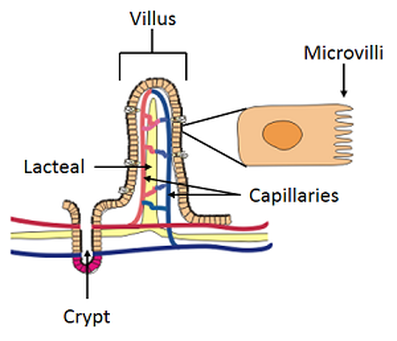

Figure 1: Structure of a villus


2.30 understand that bile is produced by the liver and stored in the gall bladder, and understand the role of bile in neutralising stomach acid and emulsifying lipids

Basically...
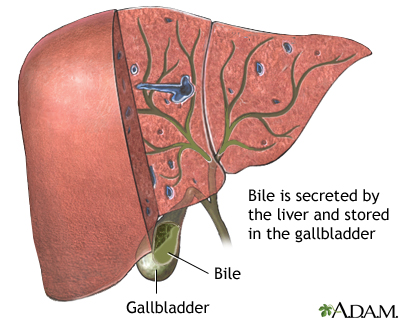
  • Bile is produced by the liver
  • It is used to neutralise the food after it has left the stomach, as it is highly acidic.
  • It emulsifies lipids, as they are not soluble in water: instead of one big oily blob, it is broken down into various tiny little blobs.
  • It is a gross shade of vomit green (but you don't need to know that)
Figure 1
(If you're a bit squeamish like I am, may I suggest that you do not look up "bile" on google images)


2.29 Understand the role of digestive enzymes, to include the digestion of starch to glucose by amylase and maltase, the digestion of proteins to amino acids by proteases and the digestion of lipids to fatty acids and glycerol by lipases.

Enzymes, as mentioned before, are biological catalysts. They help break down the food that moves through our digestive system. Different enzymes do different tasks, and break down very specific components of food:

amylase and maltase break down starch into glucose

protease breaks down proteins into amino acids

lipase breaks down lipids into fatty acids and glycerol 

Figure 1: The structure of lipids

2.28 Explain how and why food is moved through the gut by peristalsis

Food moves down the oesophagus through a process known as peristalsis. This is when the two sets of muscles in the gut contract, creating a squeezing action that moves the food down. 

This is necessary because food needs to be mechanically moved to get through the digestive system. 

Source: BBC BitesizeFigure 1: Peristalsis