Nephrons in the kidneys (contains millions of nephrons) are in charge of excretion and osmoregulation.
Excretion
Excretion is filtering the bad stuff from the body and keeping the good bits we need. The kidneys excrete water, salts and urea from the body.
The liver converts amino acids (which contain nitrogen, which is toxic to the body) into urea. The kidneys filter urea from the blood stream and combine it with water to create urine which then moves into the bladder via the urethra.
Osmoregulation
Osmoregulation is the balancing of water levels in the body (remember OSMO-sis? Therefore water-regulation)
The kidneys react to ADH hormone released by the pituitary gland.
Basically, in the nephron, there is a collecting duct. If more ADH is released, the walls of the duct will become more permeable and more water will be re-absorbed. If less, duct will become more impermeable.
Friday, April 1, 2016

2.68 Recall that the lungs, kidneys and skin are organs of excretion
Lungs
What? The lungs excrete carbon dioxide, which is a waste product of respiration. It diffuses into the lungs and is breathed out.
Why? Carbon dioxide diffuses into blood plasma and makes it more acidic. It needs to be excreted so it doesn't reach toxic levels.As blood flows through the lungs, the carbon dioxide diffuses from the red blood cell into the alveoli and is breathed out.
Higher tier
If the levels of carbon dioxide are too high, the brain will detect this. It sends signals to increase the breathing rate so carbon dioxide can be removed from the blood more quickly, and the levels return back to normal.
Kidneys
What? The kidneys excrete excess water, salt and urea through urine.
Why? (urea) Proteins are broken down into amino acids. Excess amino acids are broken down to form ammonia in the liver. It's then converted into urea (still in the liver). Although it is less toxic than ammonia, it still needs to be excreted from the body.
(water) Water is a waste product of respiration and is also taken in by food or drink. Excess water could cause the plasma to be too dilute and cause blood cells to swell and burst :( while too little water could cause the plasma to be too concentrated and the blood cells to shrivel up / shrink and stop working. It's important to keep the water concentration in the blood plasma constant.

Skin
What? The skin excretes urea, water, salt and ammonia. This is released through sweat, which is a combination of urea, salts and water and is produced by the sweat glands.
Why? Things like ammonia and urea could be toxic if left in the body for too long. (see why water needs to be excreted by the kidneys)
Structure of the kidney: see 'pages' menu on right hand side
Source: BBC Bitesize http://www.bbc.co.uk/schools/gcsebitesize/science/triple_ocr_gateway/the_living_body/waste_disposal/revision/4/
What? The lungs excrete carbon dioxide, which is a waste product of respiration. It diffuses into the lungs and is breathed out.
Why? Carbon dioxide diffuses into blood plasma and makes it more acidic. It needs to be excreted so it doesn't reach toxic levels.As blood flows through the lungs, the carbon dioxide diffuses from the red blood cell into the alveoli and is breathed out.
Higher tier
If the levels of carbon dioxide are too high, the brain will detect this. It sends signals to increase the breathing rate so carbon dioxide can be removed from the blood more quickly, and the levels return back to normal.
 |
| Figure 1 |
Kidneys
What? The kidneys excrete excess water, salt and urea through urine.
Why? (urea) Proteins are broken down into amino acids. Excess amino acids are broken down to form ammonia in the liver. It's then converted into urea (still in the liver). Although it is less toxic than ammonia, it still needs to be excreted from the body.
(water) Water is a waste product of respiration and is also taken in by food or drink. Excess water could cause the plasma to be too dilute and cause blood cells to swell and burst :( while too little water could cause the plasma to be too concentrated and the blood cells to shrivel up / shrink and stop working. It's important to keep the water concentration in the blood plasma constant.

Skin
What? The skin excretes urea, water, salt and ammonia. This is released through sweat, which is a combination of urea, salts and water and is produced by the sweat glands.
Why? Things like ammonia and urea could be toxic if left in the body for too long. (see why water needs to be excreted by the kidneys)
Structure of the kidney: see 'pages' menu on right hand side
Source: BBC Bitesize http://www.bbc.co.uk/schools/gcsebitesize/science/triple_ocr_gateway/the_living_body/waste_disposal/revision/4/
Monday, January 25, 2016
2.62 Understand that platelets are involved in blood clotting, which prevents blood loss and the entry of micro-organisms
BACKGROUND INFO
- when you cut yourself / are injured, you are at risk of losing blood
- platelets are fragments of cells
- platelets are produced in the bone marrow
EVERYTHING IS EXPLAINED :D
Platelets release chemicals when there is an open wound that turn fibrinogen into fibrin, which is a solid. This forms a mesh which traps red blood cells. It eventually dries over to form a scab, and underneath, the tissue begins to repair itself.
(life hack - if you want a wound to heal quickly, don't try to pull of the scab!!)
IN SUPER SIMPLE STEPS
P - Platelets release chemicals
FiFi - Fibrinogen turns to fibrin
M - Mesh is formed
T - Traps red blood cells
D - Dries over
S - Scab forms
R - Repair happens in tissue underneath scab
HOW TO REMEMBER THAT
Papa Fifi makes tiny dark snakes run
(whatever works for you, really)
OR
Here's an embarrassing song which might actually help:
*to the tune of twinkle twinkle little star*
Platelets release chemicals
Fibrinogen turns to fibrin.
Mesh is formed,
Traps red blood cells
It dries over
Scabs are formed
Tissue begins to repair
*insert final line here*
Again, whatever works for you. I was just...having a musical moment. Great. Now I've put it out there for the internet to see. Oh well, if it works, it's worth it :)
- when you cut yourself / are injured, you are at risk of losing blood
- platelets are fragments of cells
- platelets are produced in the bone marrow
EVERYTHING IS EXPLAINED :D
Platelets release chemicals when there is an open wound that turn fibrinogen into fibrin, which is a solid. This forms a mesh which traps red blood cells. It eventually dries over to form a scab, and underneath, the tissue begins to repair itself.
(life hack - if you want a wound to heal quickly, don't try to pull of the scab!!)
 |
| Figure 1: A lovely picture of trapped red blood cells under the mesh of fibrin - view from a microscope :) |
IN SUPER SIMPLE STEPS
P - Platelets release chemicals
FiFi - Fibrinogen turns to fibrin
M - Mesh is formed
T - Traps red blood cells
D - Dries over
S - Scab forms
R - Repair happens in tissue underneath scab
HOW TO REMEMBER THAT
Papa Fifi makes tiny dark snakes run
(whatever works for you, really)
OR
Here's an embarrassing song which might actually help:
*to the tune of twinkle twinkle little star*
Platelets release chemicals
Fibrinogen turns to fibrin.
Mesh is formed,
Traps red blood cells
It dries over
Scabs are formed
Tissue begins to repair
*insert final line here*
Again, whatever works for you. I was just...having a musical moment. Great. Now I've put it out there for the internet to see. Oh well, if it works, it's worth it :)
2.61 Understand that vaccination results in the manufacture of memory cells, which enable future antibody production to the pathogen to occur sooner, faster and in greater quantity
Vaccination in 5 simple steps!
- Person is injected with a weak or harmless sample of the pathogen / disease^
- Body fights off the disease as usual**
- Lymphocytes split, forming memory cells
- Upon re-infection*, the body produces antibodies much quicker, sooner and in greater quantity^
- Body develops 'immunity'^
(the ones that have a ^ beside it, see below for exam tips.)
Exam tips :) :)
1. I reccommend using the word "pathogen"
2. THESE ARE KEY WORDS - VERY VERY IMPORTANT TO MENTION! (the bold bit in step 4)
3. I'm not sure it's a great idea to say your body is immune because sometimes the disease does come back, or something very similar.
Extra words just for show ;)
** (step 2) this is the primary immune response.
* (step 4) this is the secondary immune response.
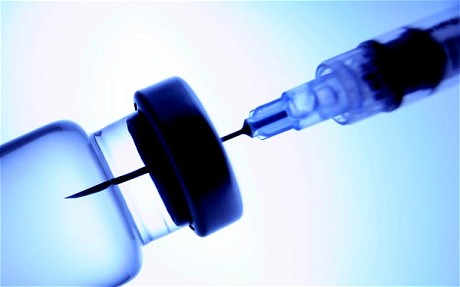 |
| Figure 1 : Tee hee, hope you're okay with needles! :P |
2.60 Describe how the immune system responds to disease using white blood cells, illustrated by phagocytes ingesting pathogens and lymphocytes releasing antibodies specific to the pathogen
What are white blood cells?
They are specialized cells that protect your body from pathogens (which can be harmful and cause disease)
I accidentally explained this in a previous post but I'll do so again:
Phagocytes
These types of white blood cells detect pathogens through a chemical trail that they leave behind. Their cytoplasm forms feelers called pseudopodia which engulf the pathogen and forms a vacuole. The phagocyte releases digestive enzymes into the vacuole which then kill / digest it (the pathogen)
This process is called phagocytosis.
Lymphocytes
These white blood cells stand back a bit compared to the phagocytes (don't say that in an exam, for the love of elves, don't!). They release antibodies which are specific / complimentary to the antigens on the surface of the pathogen (also how it recognizes it). There are various types of lymphocytes - some cause the pathogens to stick together so phagocytes can engulf them all (the string of pathogens, I mean) , others disable / neutralize the cell and others latch onto the pathogen to attract phagocytes. When a lymphocyte encounters a pathogen and produces an antibody specific to that pathogen, it splits - one of the cells becomes a memory cell (See how vaccination works) and the other releases antibodies.
Basic points on memory cells
They are specialized cells that protect your body from pathogens (which can be harmful and cause disease)
I accidentally explained this in a previous post but I'll do so again:
Phagocytes
These types of white blood cells detect pathogens through a chemical trail that they leave behind. Their cytoplasm forms feelers called pseudopodia which engulf the pathogen and forms a vacuole. The phagocyte releases digestive enzymes into the vacuole which then kill / digest it (the pathogen)
This process is called phagocytosis.
 |
| Figure 1 |
These white blood cells stand back a bit compared to the phagocytes (don't say that in an exam, for the love of elves, don't!). They release antibodies which are specific / complimentary to the antigens on the surface of the pathogen (also how it recognizes it). There are various types of lymphocytes - some cause the pathogens to stick together so phagocytes can engulf them all (the string of pathogens, I mean) , others disable / neutralize the cell and others latch onto the pathogen to attract phagocytes. When a lymphocyte encounters a pathogen and produces an antibody specific to that pathogen, it splits - one of the cells becomes a memory cell (See how vaccination works) and the other releases antibodies.
(because for some reason when I tried to put an image in, it didn't work)
Basic points on memory cells
- Memory cells created when lymphocyte splits
- Allows immune system to "remember" the disease (do not say that in an exam!!)
- Upon re-infection, immune response is faster (secondary immune response is faster)
- When the organism is re-infected, antibodies are produced much much quicker
:)
Lymphocyte types summary
- Some cause pathogens to stick together (so phagocytes engulf them all)
- Some latch onto them to attract phagocytes
- Some neutralize the cell (or disable it, same thing)
Some also make pathogens explode but I'm not sure about that one so better not mention that in an assessment, be it an exam or just a test. Basically, do not mention that in an exam unless you have researched further and know how it works.
Little extra from Annabel: Just write all four things in an exam, even if it is a 3 mark question because you never know with the mark scheme... :)
Little extra from Annabel: Just write all four things in an exam, even if it is a 3 mark question because you never know with the mark scheme... :)
2.66 Understand the general structure of the circulation system to include the blood vessels to and from the heart, the liver, the lungs and the kidneys
Quick overview of the meanings of some words:
Lung- pulmonary
Liver- hepatic
Kidney- renal
Stomach- gastric
Between the gut and liver is the hepatic portal vein.

(sorry if the diagram is a bit messy, it's hand made but hopefully accurate)
Lung- pulmonary
Liver- hepatic
Kidney- renal
Stomach- gastric
Between the gut and liver is the hepatic portal vein.

(sorry if the diagram is a bit messy, it's hand made but hopefully accurate)
2.65 Describe the structure of arteries, veins and capillaries and understand their roles
ARTERIES
Arteries take the blood Away form the heart and to an organ (e.g.: lungs)
They have thick muscular walls and a small lumen, therefore, blood is under the highest pressure in them
VEINS
Take blood to the heart and away from an organ
They have a relatively thin wall and a large lumen, therefore blood is under the lowest pressure in them
They have watch pocket valves to prevent the blood from flowing backwards/in the wrong direction
CAPILLARIES
Where exchange is taken place
They have very thin walls (one cell thick) so that gas exchange can occur easily
Subscribe to:
Posts (Atom)