Saturday, April 2, 2016

2.74 Understand that selective reabsorption of glucose occurs at the proximal convoluted tubule


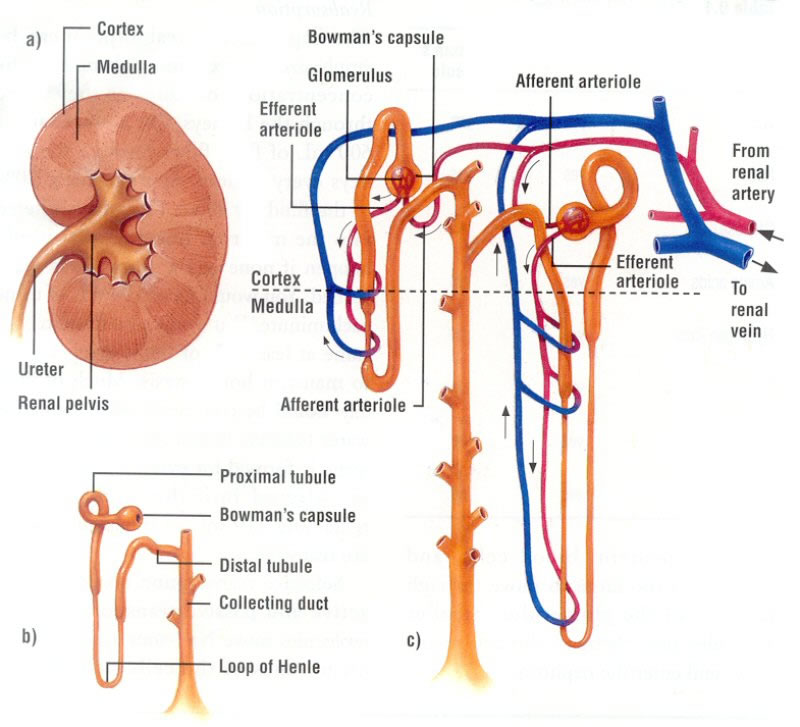
Pretty self explanatory. Basically, glucose is re-absorbed in the proximal convoluted tubule (aka the first twisty tube). This is because glucose is needed in the body for respiration. It is removed in the nephron (which is the entire yellow structure shown in the diagram above) and taken back into the blood stream.

2.73 Understand that water is reabsorbed into the blood from the collecting duct

Water is re-absorbed in the collecting duct one last time into the medulla because it is so salty. 

Following the rules of osmosis, water travels from a high concentration to a low concentration through a semi permeable membrane - that is exactly what happens, because the concentration of water in the medulla is low compared with the filtrate. However, it depends on how permeable the membrane(s) are/is: the more permeable, the more water is absorbed. I.e. if your body lacks water, the membrane will be permeable so there is no unnecessary water loss.

More about this on post 2.71

2.72 Describe ultrafiltration in the Bowman’s capsule and the composition of the glomerular filtrate

In your kidneys, there are thousands of little structures called nephrons. These are responsible for filtering the blood. It begins in the glomerulus.

The pressure in the glomerulus is high enough to squeeze some fluid out of the blood. This enters the Bowman's capsule and is known as the filtrate. It is made up of water, urea and smaller molecules and ions. But how exactly does this happen?

The blood comes in through the afferent arteriole at high pressure. It branches and becomes much smaller and the pressure increases further. The high pressure forces the plasma (liquid) into the space inside the bowman's capsule. It is now called filtrate.

Glomerular filtrate is composed of mainly water, ions (potassium, calcium, chlorine, etc.) and organic molecules.


2.71 Describe the structure of a nephron, to include Bowman’s capsule and glomerulus, convoluted tubules, loop of Henlé and collecting duct


Figure 1
Figure 1 shows the structure of a nephron. Its main features are:

  • the glomerulus
  • the bowman's capsule
  • convoluted tubules
  • the loop of Henle
  • the collecting duct
Blood enters the nephron through the glomerulus. Here, some liquid is 'squeezed' out of the blood due to the high pressure. This is known as the filtrate. Large particles / cells such as erythrocytes (red blood cells) and large amino acids are not filtered. Instead, they continue in small blood vessels. Glucose is also re-absorbed immediately into the capillaries. The filtrate goes into the bowman's capsule and that is where the filtering process begins.


The beginning is in the renal cortex and consists of the glomerulus and the bowman's capsule which surrounds it. The bowman's capsule is a cup-shaped structure that takes in the filtrate while the glomerulus is a 'knot' of capillaries in the middle. The bowman's capsule is the starting point for the filtrate.

The glomerulus is directly connected to the proximal tubule, which is the first convoluted tubule. It's basically a windy tube where mainly organic solutes are re-absorbed, along with water and things like glucose, amino acids, sodium and potassium among others.

After the Loop of Henlé, it reaches the distal tubule, which is the farther-away-curly-tube, aka the second convoluted tubule. Here, the levels of potassium, calcium and sodium are regulated. This is done by pumps and hormones. Once it is done, all of the wanted particles, water, salt, etc. have been taken out, which leaves excess water, urea and other types of metabolic waste.


The Loop of Henlé dips down into the renal medulla and is a hairpin shaped tubule. The upper section is in the outer medulla and the lower section in the inner medulla. It extracts mainly water as it travels down into the medulla. On its way up, it pumps out the salts that the body needs. This causes the medulla to become really really salty and creates a concentration gradient (medulla becomes hypertonic). The further down you go, the saltier it is. In the descending end, the membrane is highly permeable to water. Not really to salt or anything else. When the filtrate gets to the bottom of the loop (because the inner medulla is so so salty) it's highly concentrated. In the ascending end of the loop, the process happens in reverse. Here, the membrane is not-so-permeable to water and instead is lined with channels that transport ions like potassium, sodium and chlorine.


The collecting duct spans both the cortex and the medulla. In the bottom section (in the medulla), because the outside is hypertonic, even more water can be extracted (follows rules of osmosis). Hormones tell the collecting ducts how porous to make their membranes. If a membrane is made very porous, more water is absorbed into the medulla and the urine becomes even more concentrated. If the membrane is made not-very-porous, less or no water is absorbed so the urine is less concentrated.

2.70 Describe the structure of the urinary system, including the kidneys, ureters, bladder and urethra


Source: CrashCourse, YoutubeFigure 1

The urinary system is made up of:

  • the kidneys
  • the bladder
  • the ureter
  • the urethra
Looking at figure 1, you can see where each organ / part is located in the body. The functions of each part are below:
  • Kidney: filters out blood to prevent dehydration and manage the soluble substances in your blood and turns unwanted substances into urine
  • Bladder: stores urine
  • Ureter: carries urine from kidneys to bladder
  • Urethra: carries urine from the bladder to outside the body
Click here to see a video on the urinary system (seriously, it's worth it)

Friday, April 1, 2016

2.69 Understand how the kidney carries out its roles of excretion and osmoregulation

Nephrons in the kidneys (contains millions of nephrons) are in charge of excretion and osmoregulation.

Excretion
Excretion is filtering the bad stuff from the body and keeping the good bits we need. The kidneys excrete water, salts and urea from the body.

The liver converts amino acids (which contain nitrogen, which is toxic to the body) into urea. The kidneys filter urea from the blood stream and combine it with water to create urine which then moves into the bladder via the urethra.

Osmoregulation
Osmoregulation is the balancing of water levels in the body (remember OSMO-sis? Therefore water-regulation)


The kidneys react to ADH hormone released by the pituitary gland. 


Basically, in the nephron, there is a collecting duct. If more ADH is released, the walls of the duct will become more permeable and more water will be re-absorbed. If less, duct will become more impermeable.

2.68 Recall that the lungs, kidneys and skin are organs of excretion

Lungs
What? The lungs excrete carbon dioxide, which is a waste product of respiration. It diffuses into the lungs and is breathed out. 

Why? Carbon dioxide diffuses into blood plasma and makes it more acidic. It needs to be excreted so it doesn't reach toxic levels.As blood flows through the lungs, the carbon dioxide diffuses from the red blood cell into the alveoli and is breathed out.


Higher tier

If the levels of carbon dioxide are too high, the brain will detect this. It sends signals to increase the breathing rate so carbon dioxide can be removed from the blood more quickly, and the levels return back to normal.


Figure 1


Kidneys

What? The kidneys excrete excess water, salt and urea through urine. 

Why? (urea) Proteins are broken down into amino acids. Excess amino acids are broken down to form ammonia in the liver. It's then converted into urea (still in the liver). Although it is less toxic than ammonia, it still needs to be excreted from the body. 


(water) Water is a waste product of respiration and is also taken in by food or drink. Excess water could cause the plasma to be too dilute and cause blood cells to swell and burst :( while too little water could cause the plasma to be too concentrated and the blood cells to shrivel up / shrink and stop working. It's important to keep the water concentration in the blood plasma constant.


Skin

What? The skin excretes urea, water, salt and ammonia. This is released through sweat, which is a combination of urea, salts and water and is produced by the sweat glands.

Why? Things like ammonia and urea could be toxic if left in the body for too long. (see why water needs to be excreted by the kidneys)


Structure of the kidney: see 'pages' menu on right hand side

Source: BBC Bitesize http://www.bbc.co.uk/schools/gcsebitesize/science/triple_ocr_gateway/the_living_body/waste_disposal/revision/4/