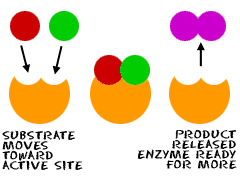
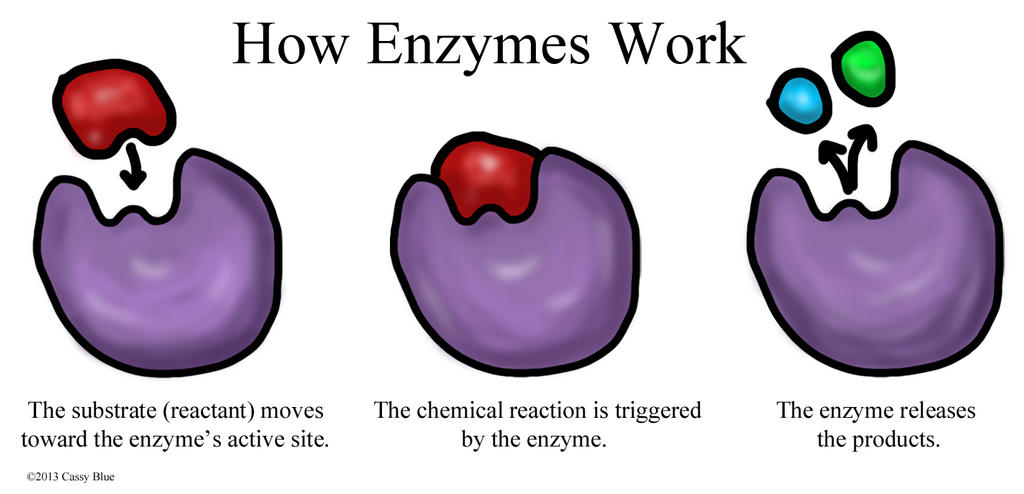
Enzymes are biological catalysts for metabolic reactions. This means that they speed up the chemical reactions needed to maintain life.
Eg digestive enzymes speed up the breaking down of food
 |
| Figure 1 |
Enzymes work best at an optimum temperature. This can be different from organism to organism, but in humans, it is about 36 - 38 ºC.
If the temperature is too low, the enzymes won't have enough energy to speed up the reaction(s) much.
If the temperature is too high, the enzymes begin to denature, meaning that their protein structures change. The shape of the active site changes and they can no longer collide with the right substrate, as it doesn't fit in the active site.
 |
| Figure 1 |
Diffusion: The random movement of particles from an area of high concentration to an area of low concentration.
Osmosis: The random movement of water particles from an area of high water concentration to an area of low water concentration through a semi-permeable membrane
Active transport: The movement of ions or molecules across a membrane from an area of low concentration to an area of high concentration, assisted by enzymes and requiring energy.
Movement of substances (water, ions, molecules, etc.) in and out of cells can happen through diffusion, osmosis, and/or active transport.
(point is pretty self explanatory)
Plants need water to perform photosynthesis. Turgid cells are cells that are full of water. Due to the cell wall, it does not burst (unlike animal cells). The cytoplasm and cell membrane is pressed against the cell wall, making the cell look "inflated" (which, it technically is but it's not great to write that in an exam)
 |
| Figure 1 |
Because the cells are turgid, they press against each other, forming a firm structure, and so are a plant's means of support.
Temperature: The higher the temperate, the faster diffusion or osmosis occurs. If the temperature is too high, however (too far past optimum), enzymes begin to de-nature and this may affect the rate of substance movement, especially in terms of active transport. Until that point, the higher the temperature, the faster the movement of particles, as they have more energy, and therefore collide more, making it more likely that they will move into the desired space.
Concentration gradient: If the concentration gradient is high/steep, it means that there is a greater difference in concentration between the substance inside and outside the cell. A steeper concentration gradient means the substance will diffuse faster because molecules have a bigger opportunity of diffusing.
Surface area to volume ratio: If there is a larger surface area to volume ratio, the movement of the substance is likely to be quicker, especially in terms of diffusion, as there is a larger space that particles can get past.
In order from smallest to largest....
Organelles
- Have a specific function inside the cell
- Made up of small molecules
- Example: mitochondria, ribosomes, etc.
Cells
- The basis of all living things
- Said to be a functional unit
- Made up of organelles
- Examples: red blood cells, white blood cells, etc.
Tissues
- Made up of many cells
- Cells serve a common function
- Examples: muscle tissue, neural tissue
Organs
- Made up of tissues
- Form a large functioning unit
- Examples: liver, heart, etc.
Organ systems
- Made up of many organs
- Serve a common or related function in the body
- Many organs working together
- Examples: respiratory system, skeletal system, etc.
 |
| Figure 1 |