Hello everyone!
I've been away for a long time and I am glad to say I've graduated! I will be pursuing engineering soon. In the meantime, I hope this blog has helped you. Feel free to post corrections and comments. As a student, I know finances will be difficult, so I ask only a minute of your time to check out my Redbubble shop. It is a website that supports independent artists like me. With every purchase you make, I get a small commission. Art is a small passion of mine and it would mean the world to me if you could share this with friends and family so that I might earn a little from this hard work.
On this website: https://www.redbubble.com/people/Carolemonn/shop?asc=u you can find original watercolor works and more which can be printed on a variety of products, from shirts to mugs. Enjoy!
Thank you for your support and all the best with revision!
~ Carolina
Thursday, May 30, 2019

Tuesday, April 4, 2017
3.5 Understand the conditions needed for seed germination
Seeds require:
- Water
- Oxygen
- Warmth
A good way to remeber this is "WOW" (I didn't come up with that, credit to another user, which will remain anonymous.)
3.4 Understand that the growth of the pollen tube followed by fertilisation leads to seed and fruit formation
The pollen tube grows from the stigma, down through the style and into the ovary. This is where fertilisation occurs and it leads to the formation of a seed and/or a fruit. This is quite obviously seen in citrus fruits, such as a lemon, or fruits such as tomatoes (see below)

3.3 Describe the structures of an insect-pollinated and a wind-pollinated flower and explain how each is adapted for pollination
 |
| Figure 1.1 (source: Google Images) |
Insect pollinated flowers:
- Large, bright petals to attract insects
- Scented, often with nectar, to attract insects
- Moderate number of pollen grains so they are transferred efficiently by insects
- Sticky or spiky pollen grains, so they stick to insects
- Anthers are located inside the flower (rather than outside) and are firmly attached, so they brush against insects when they try to get the nectar
- The stigma is also inside. It is sticky so pollen grains from insects stick to it when they brush past.
Wind pollinated flowers:
- Small petals with little color - often green or brown
- No scent or nectar because they do not need to appeal to insects
- Large amounts of pollen to increase the chances of it being transferred to another flower
- Anthers are on the outside and filaments are longer so pollen grains are more easily swept away by the wind
- Feathery stigmas form a network outside the flower that helps to catch more pollen from the wind.
3.2 Understand that fertilisation involves the fusion of a male and female gamete to produce a zygote that undergoes cell division and develops into an embryo
Fertilisation involves the fusion of a male and female gamete. In mammals, this is the sperm (male) and egg (female). This produces a zygote, which undergoes division by mitosis (so all the cells produced are identical) and eventually develops into an embryo.
At this stage, the cells are unspecialised. They later develop into more specific cells (i.e skin, muscle, brain, blood, etc)
At this stage, the cells are unspecialised. They later develop into more specific cells (i.e skin, muscle, brain, blood, etc)
3.1 Understand the differences between sexual and asexual reproduction
Asexual reproduction
- Involves no gametes and only one parent
- Produces genetically identical offspring (clones)
- Commonly happens in plants
- Involves division of cells by mitosis
- Produces more offspring
Sexual reproduction
- Requires two parent organisms
- Produces fewer number of offspring
- Genetic variety in offspring, allows for them to adapt, should the environment change
- Provides offspring a greater chance of survival in changing conditions
- Involves the fusion of gametes
Wednesday, February 22, 2017
5.18 Understand how micropropagation can be used to produce commercial quantities of identical plants (clones) with desirable characteristics
| Source: https://bam.files.bbci.co.uk/bam/live/content/zh6gd2p/large |
- A tissue sample is taken from a 'parent plant'
- It is placed in agar containing appropriate nutrients
- They develop into plantlets
- Transferred to compost where they fully develop
This can be advantageous because:
- It allows a farmer to genetically modify one plant and pass on the modification to many thousands of plants
- Plants grow quicker than they would from the seed
- A (natural) desired trait can be 'copied' into hundreds and thousands of other plants
Its disadvantages are:
- Very small gene pool, which means a disease can wipe out all of the plants at once
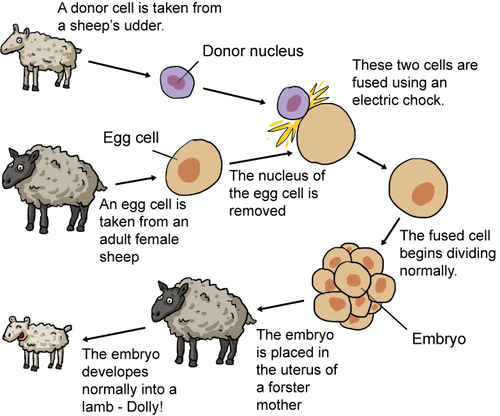
5.19 Describe the stages in the production of cloned mammals involving the introduction of a diploid nucleus from a mature cell into an enucleated egg cell, illustrated by Dolly the sheep
The stages are as follows:
- Remove a donor (diploid) cell with the full genetic information (contained in the nucleus)
- A cell must be obtained, but one with the capacity to divide. Thus, an egg cell is taken from a sheep.
- The egg cell nucleus is removed (it is enucleated)
- Desired DNA is placed into the egg cell. They are fused together with an electric shock.
- This newly combined cell divides by mitosis to produce a sheep embryo.
- The embryo is placed into the womb of another sheep (the surrogate mother)
- As the cells continue to divide, it will grow into a fetus and eventually be born.
The cloned sheep will have the DNA of the cell donor.
 |
| Source: http://media1.shmoop.com/images/biology/biobook_biotechnology_graphik_18.png |
5.20 Evaluate the potential for using cloned transgenic animals, for example to produce commercial quantities of human antibodies or organs for transplantation.
As mentioned, one use of cloned, transgenic animals (meaning they have had another organism's DNA inserted into them) is to produce commercial quantities of human antibodies or organs for transplantation. Some examples include:
Animals can be given genes to produce human antibodies, which can be later injected into humans to help them face infection, rather than allow the immune system to find the appropriate antibody (which would likely take much longer).
Sheep and cows can be modified to produce human proteins in their milk, which makes it more beneficial for us.
Animals with organs similar enough to human ones can be used for transplants, which would significantly reduce the problem of shortages. However, this may be a problem for ethical reasons (i.e. it can be considered inhumane to breed animals only to cut out their organs)
There are advantages and disadvantages of the process:
😃
- Cows with medicine in their milk can be cloned
- Pigs with human hearts can be cloned for organ transplant
Animals can be given genes to produce human antibodies, which can be later injected into humans to help them face infection, rather than allow the immune system to find the appropriate antibody (which would likely take much longer).
Sheep and cows can be modified to produce human proteins in their milk, which makes it more beneficial for us.
Animals with organs similar enough to human ones can be used for transplants, which would significantly reduce the problem of shortages. However, this may be a problem for ethical reasons (i.e. it can be considered inhumane to breed animals only to cut out their organs)
There are advantages and disadvantages of the process:
😃
- Cloning can happen at any time of year (out of breeding season)
- Infertile animals can be cloned
- Desired traits can be passed on with almost 100% certainty
😓
- Cloned animals may develop problems
- Cloning is a relatively new technology, meaning that it may have negative consequences that we are not aware of
- Low success rate (many animals will die horrible deaths)
- Difficult, time-consuming and expensive
Saturday, September 17, 2016
3.17 Understand the meaning of the terms: dominant, recessive, homozygous, heterozygous, phenotype, genotype and codominance
Homozygous: two same alleles of a gene on each chromosome on a homologous pair
Heterozygous: one of each allele of a gene on each chromosome on a homologous pair
Rescessive: an allele only expressed if the dominant allele is absent or if [the recessive gene] is homozygous.
Dominant: an allele that always express itself whether it is heterozygous or homozygous
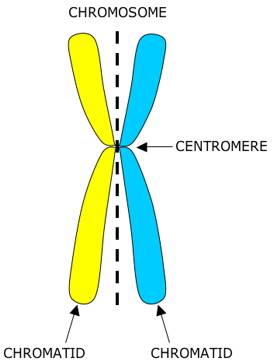
Homologous pair: a chromosome containing a maternal and paternal chromatid joined together. (these have the same gene but may have different alleles)
Chromatid: each of the two threadlike strands that chromosomes divide into during mitosis.
3.16 Understand that genes exist in alternative forms called alleles which give rise to differences in inherited characteristics
Genes exist in alternative forms called alleles. These control the differences in inherited characteristics.
Extra information:
Alleles can be dominant or recessive, homozygous or heterozygous. They are written as big or small letters. Eg: Aa or AA or aa. This is known as a genotype. The physical characteristic it codes for is called a phenotype.
Extra information:
Alleles can be dominant or recessive, homozygous or heterozygous. They are written as big or small letters. Eg: Aa or AA or aa. This is known as a genotype. The physical characteristic it codes for is called a phenotype.
3.15 Describe a DNA molecule as two strands coiled to form a double helix, the strands being linked by a series of paired bases: adenine (A) with thymine (T), and cytosine (C) with guanine (G)
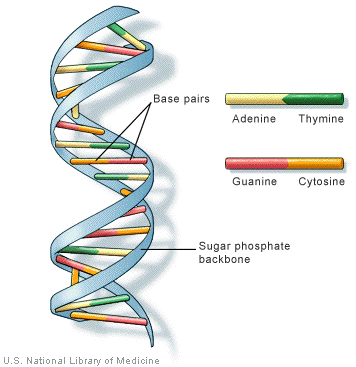
- Adenine (A)
- Thymine (T)
- Guanine (G)
- Cytosine (C)
Adenine always pairs up with thymine, guanine always pairs up with cytosine. The order in which these are paired in is what makes up the 'coding' of an organism.
(Virtual flashcards on this topic can be found here, or click 'inheritance flashcards' on the right hand side menu)
Friday, September 16, 2016
3.14 Understand that a gene is a section of a molecule of DNA and that a gene codes for a specific protein
A gene is a length of DNA. This codes for a specific protein. These proteins join together to make a chain.
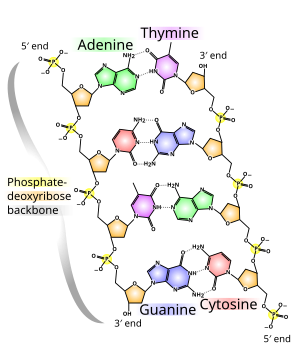 |
| Structure of DNA |
3.13 Understand that the nucleus of a cell contains chromosomes on which genes are located

If you unwrapped a chromosome, you would see it is essentially just strands of DNA coiled around a protein. DNA stands for deoxyribonucleic acid (you don't need to know that).
Wednesday, June 1, 2016
4.7 Explain why only about 10% of energy is transferred from one trophic level to the next.
- Some energy is used at the current trophic level in life processes
- Some food the organism takes up is undigested and passed as faeces
- Organism might not eat everything (i.e. a rabbit won't eat a cabbage's roots, so won't gain 100% of its energy even if no energy was used by the cabbage)
4.6 Understand the transfer of substances and of energy along a food chain
When one organism eats another, the substances and energy from it get transferred to its consumer. I.e. if you eat a kilo of spinach, the energy and nutrients from that are transferred to you (don't try that please)
2.90 understand the sources, roles and effects of the following hormones: ADH, adrenaline, insulin, testosterone, progesterone and oestrogen

Tuesday, May 31, 2016
2.84 Understand that the central nervous system consists of the brain and spinal cord and is linked to sense organs by nerves
The central nervous system consists of:

- brain
- spinal cord
and is linked to sense organs (i.e. eyes, tongue, touch receptors) by nerves
2.83 Describe how responses can be controlled by nervous or by hormonal communication and understand the differences between the two systems
Endocrine (hormonal) system
- Long lasting response
- Widespread effect
- Hormones produced all over the body, carried by plasma
- Pituitary gland and hypothalamus are key players
Nervous
- Short lived but very quick
- Localised; specific to an area
- Often involves the contraction of a muscle
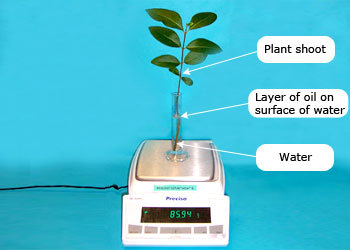
2.56 Describe experiments to investigate the role of environmental factors in determining the rate of transpiration from a leafy shoot
- Weigh the plant at the start
- Put it in a test tube with only its roots / end in the water
- Put a layer of oil over water
- Leave for x amount of time
- Weigh plant again
- Record results
- Repeat, changing one variable (i.e temperature)
Subscribe to:
Posts (Atom)