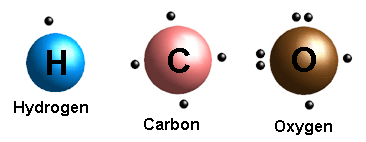
Word: carbon dioxide + water → glucose + oxygen
Monday, October 26, 2015
2.5 Identify the chemical elements present in carbohydrates, proteins and lipids (fats and oils)
2.2 Describe cell structures, including the nucleus, cytoplasm, cell membrane, cell wall, chloroplast and vacuole
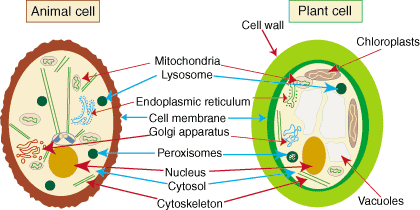
Cell structures
- Nucleus - controls the cell's behavior
- Cytoplasm - makes up most of the cell, a gelatine-like subtance
- Cell membrane - a thin wall that keeps the cell together
- Cell wall - a harder, outer wall that keeps the cell's shape and stops it from bursting when it is full of water
- Chloroplast - allows the organism to photosynthesize: to produce glucose from water and carbon dioxide
- Vacuole - Where cell sap is stored, along with other nutrients
Key
Yellowish orange = Features in both plant and animal cells
Green = Typically associated with plant cells
Pale purple = Typically associated with plant cells, but a small temporary vacuole can be found in animal cells too
| Figure 1: An unnecessarily complicated comparison |
2.3 Describe the functions of the nucleus, cytoplasm, cell membrane, cell wall, chloroplast and vacuole
(Also covered in 2.2)
Functions:
- Nucleus - controls the cell's behavior
- Cytoplasm - makes up most of the cell, a gelatine-like subtance. This is where the organelles are found.
- Cell membrane - a thin wall that keeps the cell together
- Cell wall - a harder, outer wall that keeps the cell's shape and stops it from bursting when it is full of water
- Chloroplast - allows the organism to photosynthesize: to produce glucose from water and carbon dioxide
- Vacuole - Where cell sap is stored, along with other nutrients
| Figure 1 (yes I know, same image again. Sozzles.) |
2.4 Compare the structures of plant and animal cells
Part of structure Present in plant c. Present in animal c.
Nucleus Yes Yes
Cytoplasm Yes Yes
C. membrane Yes Yes
Vacuole Yes (permanent) Yes (but not permanent)
C. wall Yes No
Chloroplast(s) Yes No
Further comparison
Nucleus Yes Yes
Cytoplasm Yes Yes
C. membrane Yes Yes
Vacuole Yes (permanent) Yes (but not permanent)
C. wall Yes No
Chloroplast(s) Yes No
Further comparison
- In plant cells, the vacuole is large and permanent, while in animal cells, it tends to be small and is not permanent.
- Animal cells will burst if they are filled with too much water (turgid) but plant cells will not (due to the cell wall)
2.6 Describe the structure of carbohydrates, proteins and lipids as large molecules made up from smaller basic units
2.7 Describe the tests for glucose and starch
Glucose
Put a few drops of benedict's solution in a test tube of the substance that you want to test for glucose and place it in a warm waterbath. Leave it for a few minutes. It will be blue, initially. If there is any change in colour, glucose is present.
Starch
Put a drop of iodine solution on whatever you wan to test for starch (let's say, a cornflake). If there's a change in colour, starch is present.
Put a few drops of benedict's solution in a test tube of the substance that you want to test for glucose and place it in a warm waterbath. Leave it for a few minutes. It will be blue, initially. If there is any change in colour, glucose is present.
| Figure 1: Test for sugar scale |
Put a drop of iodine solution on whatever you wan to test for starch (let's say, a cornflake). If there's a change in colour, starch is present.
| Figure 2: The test for starch, using a potato as an example |
Subscribe to:
Posts (Atom)